My proposal for a nationwide, secure, easy, online voting system.
In the United States, people already trust their phones and computers with some of the most sensitive parts of their lives. We move money through banking apps, file taxes online, and store medical records in secure digital systems. Yet when it comes to voting, the most basic act of democracy, we still rely on paper ballots, polling places, and a patchwork of state rules.
This gap is not about technology. The tools exist. What is missing is a national system designed for security, transparency, and fairness. This article lays out a detailed plan for MyVote, a federally owned and operated voting app. MyVote would allow Americans to vote securely from their phones or computers, while still offering a paper option for those who prefer it.
Why MyVote?
The goal of MyVote is to make voting secure, accessible, and trustworthy. It would be:
Publicly owned: No private companies would run the servers or control the data. Everything would be managed by a federal agency.
Nationwide: Federal elections would be run under one set of rules, with the Electoral College eliminated. Every vote would count equally.
Flexible: The app would also support state and local elections, with ballots that adjust automatically based on where a voter lives.
Redundant: Servers would be spread across regions, with backups to prevent outages.
Auditable: Every vote would leave a secure, verifiable trail that voters and auditors could check.
Accessible: Overseas voters, voters with disabilities, and those without reliable mail access would have equal participation.
Optional: Paper ballots would remain available for anyone who does not want to vote digitally.
How MyVote Would Work
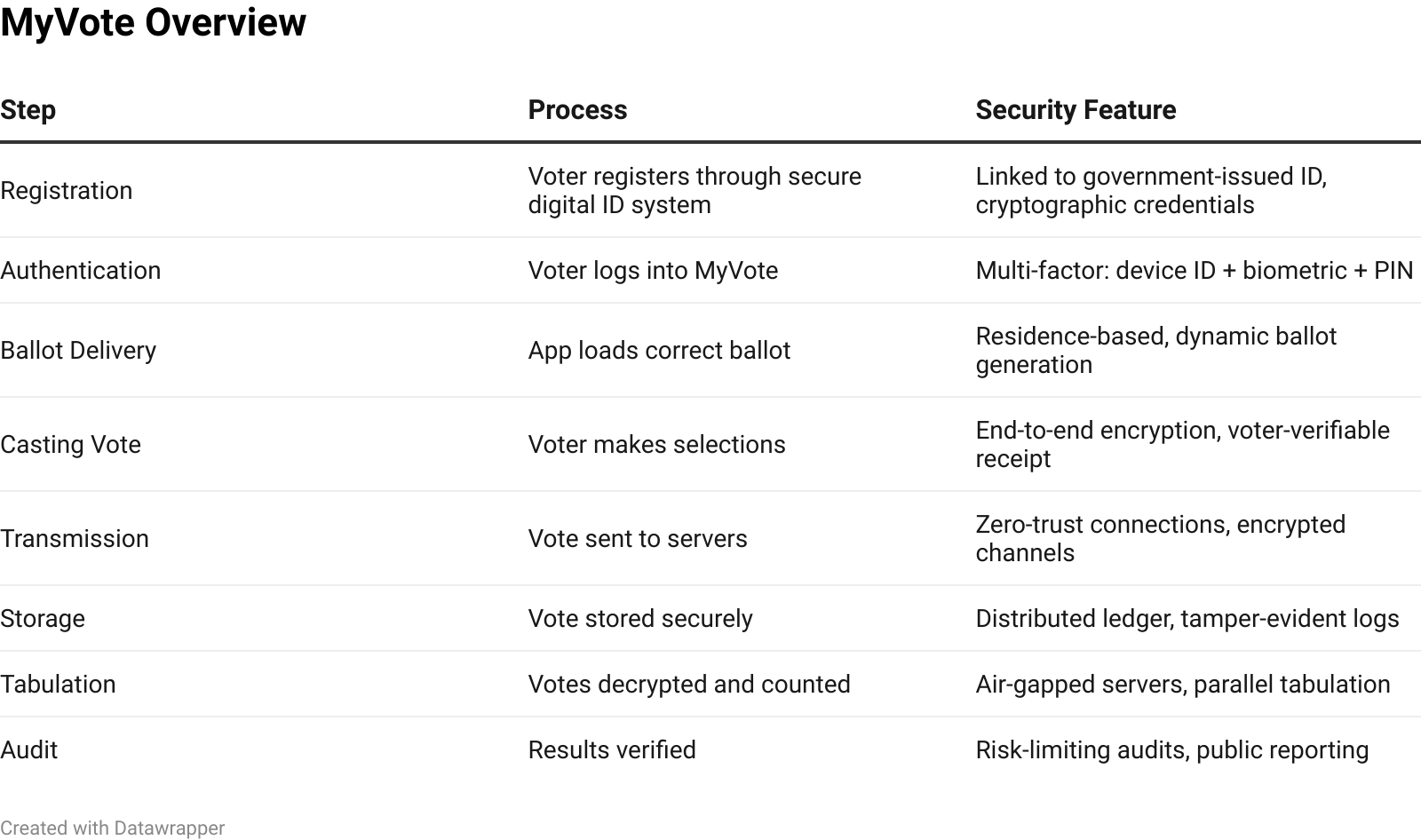
Here is a simple overview of the system:
Secure ID and Voter Registration
Many states are already moving toward digital IDs. Mobile driver’s licenses and digital ID cards are being tested in states like Arizona, Maryland, and Colorado. These IDs use encryption and biometrics to confirm identity for banking, airport security, and government services.
MyVote could connect directly to these systems. When someone receives a digital ID, they could also be automatically registered to vote. This would:
Reduce errors in voter rolls
Prevent duplicate registrations
Ensure every eligible citizen has a verified identity for voting
Fraud Prevention and Security
The most common objection to online voting is that it cannot be made secure. Critics worry about hacking, fraud, and manipulation. But the truth is that we already run digital systems with higher stakes than elections: banking, stock markets, classified communications, and even nuclear command and control. The key is to design MyVote with layered defenses that protect every stage of the process.
Fraud prevention is not one feature. It is a chain of protections that begins with voter registration and ends with public audits. If one layer fails, the others still hold.
Stage 1: Voter Registration Integrity
Secure digital IDs: Registration is tied to government-issued digital IDs, which are already being piloted in states like Arizona, Maryland, and Colorado.
Automatic updates: Voter rolls update automatically when someone moves, changes their name, or passes away, using data from Social Security, DMV, and other agencies.
Cryptographic credentials: Each voter receives a unique digital certificate that cannot be duplicated or forged.
Stage 2: Authentication
Multi-factor login: Device ID + biometric (fingerprint or face) + personal PIN.
One-time voting tokens: Each voting session requires a single-use cryptographic token, preventing replay attacks.
Device health check: The app scans for malware before allowing a vote to be cast.
Stage 3: Ballot Casting
End-to-end encryption: Votes are encrypted on the device and remain encrypted until counted.
Voter-verifiable receipt: Each voter receives a cryptographic receipt that confirms their vote was recorded, without revealing their choice.
Re-cast option: Like Estonia, voters can re-cast their ballot during the voting window. Only the final vote counts, which reduces coercion and vote-buying risks.
Stage 4: Transmission and Storage
Zero-trust connections: Every connection is verified; no device or server is implicitly trusted.
Encrypted channels: Votes travel only through secure, encrypted pathways.
Distributed ledger: A blockchain-style ledger records every vote in a tamper-evident, publicly auditable format.
Regional redundancy: Servers are spread across multiple jurisdictions with real-time backups.
Tamper-evident logs: All system actions are cryptographically signed.
Stage 5: Tabulation
Air-gapped servers: Votes are decrypted and counted only on isolated, federally owned servers.
Parallel tabulation: Independent systems tally results and cross-verify totals.
Chain-of-custody protocols: Every transfer of data is logged and verified by bipartisan oversight teams.
Stage 6: Auditing and Oversight
Risk-limiting audits: Statistical audits confirm that results match the reported outcome.
Independent penetration testing: Conducted before and after each election by third-party cybersecurity firms.
Open-source code: Publicly available for inspection, ensuring transparency.
Public reporting: All audit results, penetration test findings, and system logs are published.
Infrastructure and Governance
Why Infrastructure Matters
Security is not only about encryption and software. It also depends on the physical and organizational systems that support the technology. If servers are privately owned or concentrated in one location, they become single points of failure. To prevent this, MyVote would rely on federally owned, regionally distributed infrastructure. This ensures that no private company controls the backbone of American elections and that no single outage could disrupt voting.
Federally Owned Data Centers
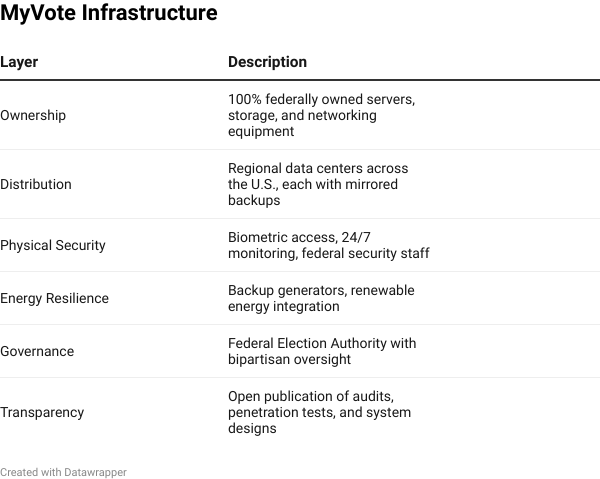
Public ownership: All servers, storage, and networking equipment would be owned and operated by the federal government. No reliance on Amazon Web Services, Microsoft Azure, Google Cloud, or other private vendors.
Regional distribution: Data centers would be spread across the country, with at least one in each major region (Northeast, Southeast, Midwest, Southwest, West Coast).
Real-time backups: Each center would mirror data to at least two others, ensuring continuity even if one site fails.
Physical security: Facilities would be protected with biometric access controls, 24/7 monitoring, and federal security staff.
Energy resilience: Backup generators and renewable energy sources would keep systems online during power outages.
Governance Structure
Federal Election Authority (FEA): A new independent agency would oversee MyVote. It would be separate from partisan control, with leadership confirmed by Congress.
Uniform federal rules: Federal elections would be run under one set of rules, eliminating the patchwork of state systems.
State participation: States would continue to run state and local elections but could use MyVote infrastructure. Federal funding and technical support would encourage adoption.
Transparency: All system designs, audits, and security reports would be published for public review.
Oversight: Bipartisan boards at the federal, regional, and state levels would monitor operations and audits.
Why Federal Control Matters
Today, elections are run by states, which creates inconsistent rules, outdated technology, and uneven security. By federalizing the infrastructure for federal elections, MyVote would:
Guarantee equal access for all voters
Eliminate reliance on private vendors and proprietary systems
Provide consistent security standards nationwide
Ensure that federal elections are run as a public trust, not a commercial service
Auditability and Voter Verification
Why Auditability Matters
A secure voting system is not enough on its own. Voters must be able to trust that their ballot was recorded correctly, and the public must be able to verify that the reported results match the actual votes. MyVote would be designed with transparency at its core. Every vote would leave a trail that can be checked by the voter, by independent auditors, and by the public.
Voter Verification
Cryptographic receipts: After casting a ballot, each voter receives a receipt containing a unique code. This code does not reveal how they voted but allows them to confirm that their ballot is included in the final tally.
Re-cast option: Voters can re-cast their ballot during the voting window. Only the final vote counts. This prevents coercion and ensures that voters can correct mistakes.
Paper audit option: For voters who request it, a paper copy of their ballot can be mailed to them after the election for verification.
System-Level Auditing
Risk-limiting audits (RLAs): Statistical methods are used to confirm that the reported results match the actual votes. RLAs can detect even small discrepancies.
Parallel tabulation: Votes are counted by two independent systems. Results are compared to detect any irregularities.
Tamper-evident logs: Every action in the system is recorded and cryptographically signed. Any attempt to alter data would be visible.
Independent penetration testing: Security experts test the system before and after each election to identify vulnerabilities.
Public Transparency
Open-source code: The MyVote software would be published for public review. Anyone could inspect it for flaws or backdoors.
Audit reports: All audit results, penetration test findings, and system logs would be published online.
Citizen oversight: Bipartisan citizen boards at the federal and regional levels would review audits and report findings to the public.
Auditability ensures that no single authority has to be trusted blindly. Voters can confirm their own ballots. Auditors can confirm the system’s accuracy. The public can review the process. By combining cryptographic verification, statistical audits, and open transparency, MyVote would create a system where fraud is not only difficult but also detectable.
Democratic Reform and the End of the Electoral College
Why Reform Is Necessary
The current U.S. election system is fragmented. Federal elections are run by states, each with its own rules, technologies, and procedures. This creates unequal access, inconsistent security, and confusion for voters. On top of that, the Electoral College distorts representation by giving disproportionate weight to smaller states and swing states. Millions of votes in safe states effectively carry less influence.
MyVote would address both problems by creating a federalized, uniform system for federal elections and by moving to a direct national popular vote.
One Person, One Vote
Direct vote count: Every ballot cast in MyVote would count equally, regardless of where the voter lives.
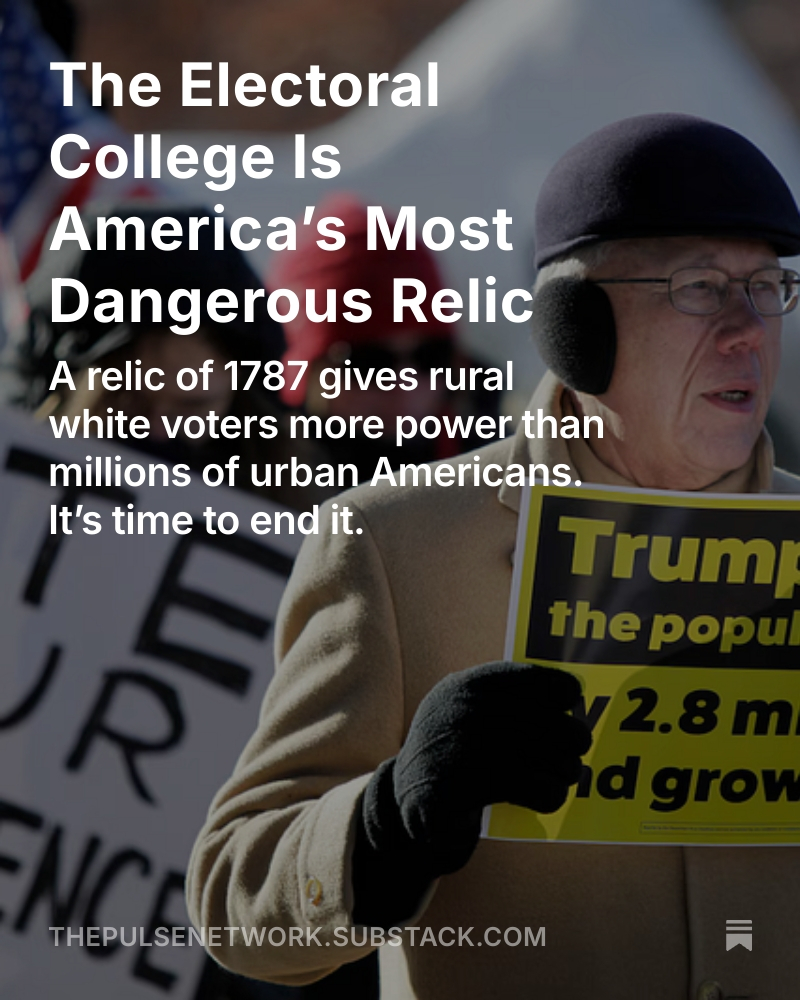
Elimination of the Electoral College: The presidency would be decided by the total number of votes nationwide (popular vote).
Equal representation: Voters in large states and small states would have the same weight in determining the outcome.
Federal Control of Federal Elections
Uniform rules: Federal elections would follow one set of standards for registration, authentication, ballot design, and auditing.
State role: States would continue to manage state and local elections but could use MyVote infrastructure for consistency.
Encouragement to adopt: Federal funding and technical support would incentivize states to use MyVote for all elections, not just federal ones.
Benefits of Reform
Clarity: Voters would no longer face different rules depending on their state.
Fairness: Every vote would carry the same weight in federal elections.
Security: A single federal system would allow for stronger, uniform protections.
Trust: Transparency and auditability would be consistent nationwide.
Addressing Concerns and Building Public Trust
Why Concerns Must Be Addressed
Even the most secure system will fail if the public does not trust it. MyVote must not only be secure, but it must also be seen as secure. That means addressing common objections head-on: security risks, access issues, and misinformation about voter eligibility.
Concern 1: Security
Claim: Online voting is too risky. Hackers will find a way in.
Response: MyVote uses the same protections that safeguard financial markets and classified government systems. End-to-end encryption, multi-factor authentication, zero-trust architecture, and tamper-evident logs make unauthorized access extremely difficult. Even if one layer is breached, others remain in place.
Concern 2: Access
Claim: Not everyone has a smartphone or internet access.
Response: MyVote does not replace paper ballots. A mail-in option remains available for anyone who prefers it. Public libraries, community centers, and election offices could also provide secure voting kiosks for those without personal devices, where voters could use their digital voter ID.
Concern 3: Integrity of Results
Claim: Results could be manipulated without anyone knowing.
Response: MyVote is designed for transparency. Voters receive cryptographic receipts to confirm their ballot was counted. Independent audits, parallel tabulation, and open-source code make manipulation visible and correctable.
Concern 4: False Claims About “Illegal Immigrants” Voting
Claim: Non-citizens, especially undocumented immigrants, are voting in large numbers.
Response: This claim is false. Multiple studies, including those reviewed by the Brennan Center for Justice and the Associated Press, have found that non-citizen voting in U.S. elections is extremely rare and statistically insignificant. MyVote would make it even harder for ineligible individuals to vote by tying registration to secure digital IDs and cryptographic voter credentials. Only verified U.S. citizens would receive credentials. Automatic cross-checks with Social Security, DMV, and immigration databases would prevent fraudulent registrations.
Concern 5: Privatization
Claim: Private companies cannot be trusted to run elections.
Response: MyVote would be 100% federally owned and operated. No private vendors would control the servers, the app, or the data. Elections remain a public trust, not a commercial product.
Pulling It All Together
The MyVote system is not just a technical proposal. It is a blueprint for modernizing American democracy. It combines federal ownership, layered security, transparent auditing, and equal representation into one coherent framework.
Security: End-to-end encryption, multi-factor authentication, zero-trust architecture, and tamper-evident logs protect every stage of the process.
Fraud Prevention: Secure digital IDs, cryptographic credentials, and automatic voter roll updates ensure only eligible citizens can vote. False claims about “illegal immigrants” voting are addressed directly by tying registration to verified government-issued IDs.
Infrastructure: Federally owned, regionally distributed servers with real-time backups eliminate reliance on private vendors and prevent outages.
Auditability: Voter-verifiable receipts, risk-limiting audits, and open-source code guarantee transparency.
Democratic Reform: Abolishing the Electoral College ensures one person, one vote in federal elections.
Public Trust: By addressing concerns openly and publishing audits, MyVote would strengthen confidence in elections.
The United States faces declining trust in elections, fueled by misinformation and outdated systems. Long lines, inconsistent rules, and false claims about voter fraud undermine confidence. MyVote offers a way forward: a system that is secure, fair, and transparent, designed for the 21st century.
The Reality
Building MyVote will not be easy. It requires political will, federal investment, and public education. But the alternative is to continue with a system that is fragmented, vulnerable, and increasingly distrusted.
Congress should establish a Federal Election Authority to design and operate MyVote.
States should integrate their digital ID systems with federal voter registration.
Citizens should demand a system that treats voting with the same seriousness as banking, healthcare, and national security.
We already trust our phones with our money, our health, and our identities. It is time to trust them with our votes. MyVote would not replace democracy; it would strengthen it, making elections more secure, more accessible, and more representative.
The future of American democracy depends on building systems that are both technically sound and publicly trusted. MyVote is one way to get there.

Josh Schooley is a seasoned accountant and business management professional with over 25 years of experience, but his passion for truth and transparency extends far beyond numbers. As the founder of The Pulse Network, Josh has built a reputation for delivering fact-based political analysis and cutting through misinformation in an era of spin.
A proud husband, father, and grandfather, Josh uses his platform to advocate for LGBTQ+ rights, social justice, and progressive policies. His presence on Threads has become a hub for sharp political commentary, where he engages with thousands of followers, exposing hypocrisy and holding leaders accountable.
Josh’s work has resonated with readers who seek clarity, honesty, and a no-nonsense approach to politics. Whether he’s dissecting the latest policy shifts or calling out political corruption, his voice remains a powerful force in the fight for democracy and equality.